
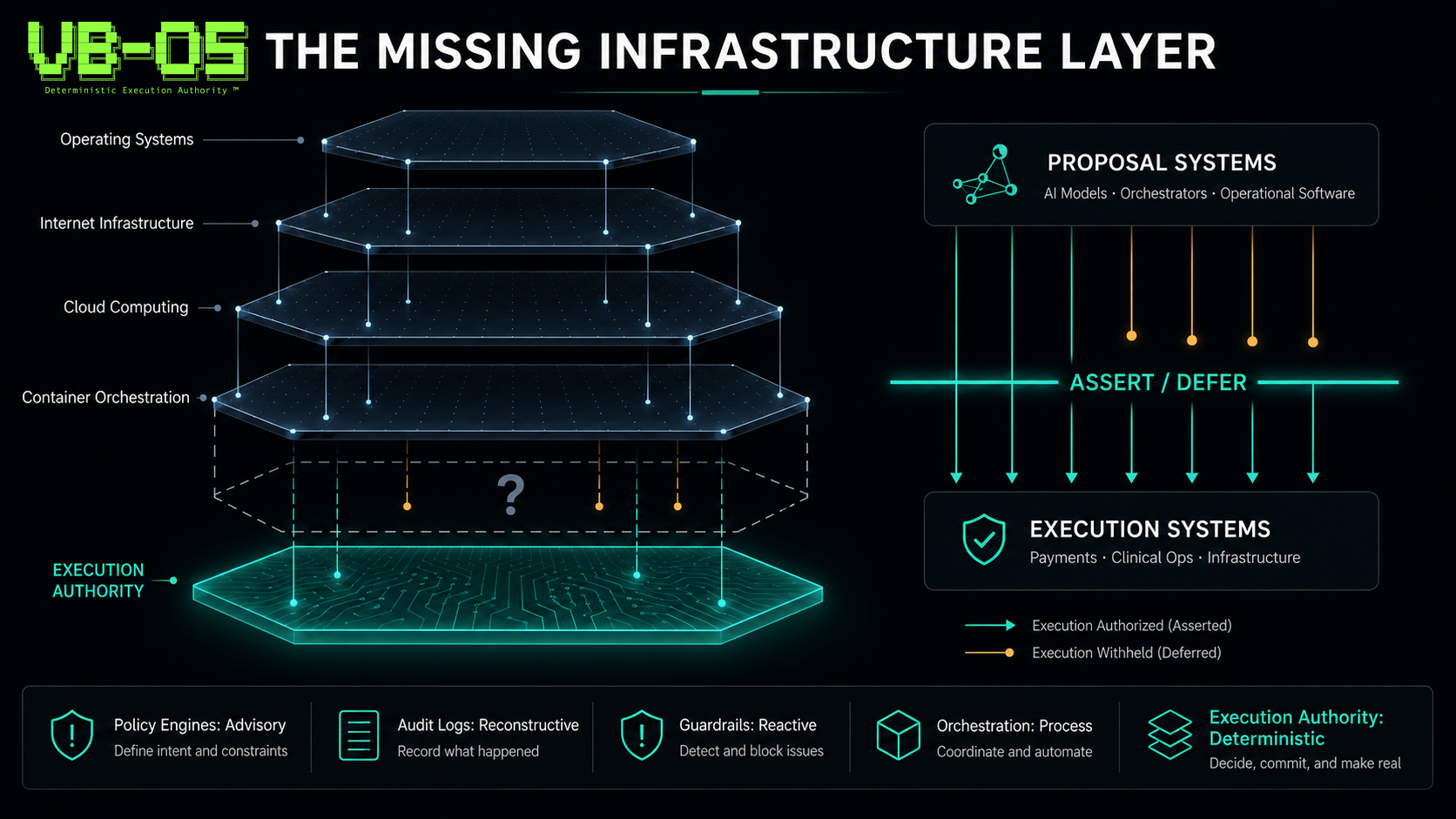
Infrastructure Evolution
Operating Systems
Internet Infrastructure
Cloud Computing
Container Orchestration
Execution Authority
Independent authorization determination
MissingEvery Computing Era Adds a Layer
Operating systems abstracted hardware. Internet infrastructure abstracted networking. Cloud computing abstracted provisioning. Container orchestration abstracted deployment consistency.
Each of these layers emerged at the same structural inflection point: a capability became universally necessary, yet impossible for individual applications to reliably own themselves.
No application should manage its own memory allocation. No service should negotiate its own TCP connections. No workload should provision its own compute. These capabilities moved from application-level concerns into infrastructure because they had to. The alternative, every application implementing its own version, produced fragility, inconsistency, and operational failure at scale.
The pattern is consistent. The question is always the same: what capability has become universally necessary but remains embedded inside individual applications?
Autonomous Systems Changed the Nature of Execution
For most of computing history, systems computed. They accepted input, processed data, and returned output. The operational consequence of that output, whether it was acted upon, remained a human decision.
That separation is dissolving.
Operational systems now propose actions, not just calculations. Payment authorizations execute. Clinical workflow progressions advance. Infrastructure modifications deploy. Containment responses trigger. Automated approvals release.
These are not calculations waiting for human review. They are operational decisions executing at machine speed, often without human intermediation.
The problem is no longer computation. The problem is execution authority.
When a system proposes an operational action, something must independently determine whether that action is authorized. Not whether it is computationally correct. Whether it is authorized. This includes payments, containment actions, clinical progressions, and infrastructure changes.
Existing Approaches Do Not Occupy This Layer
Several established categories address adjacent concerns. None occupy the execution authority layer itself.
Policy engines define advisory rules. They express what should happen under certain conditions. They are mutable, operationally embedded, and advisory by design. They do not independently produce authorization.
Audit logs record events after they occur. They preserve historical sequences. They are reconstructive — they allow investigators to infer what happened. They do not reproduce what was authorized or why.
Guardrails filter output from generative systems. They are reactive and probabilistic — they catch problematic outputs after generation. They do not govern whether execution is authorized before it occurs.
Orchestration platforms coordinate workflow execution. They manage sequencing, routing, and operational flow. They automate process. They do not independently determine whether the actions they coordinate are authorized.
Observability systems provide visibility into operational behavior. They surface metrics, logs, and traces. They make systems legible. They do not govern execution.
None of these independently determine whether execution is authorized at the moment of action.
Existing Approaches
None independently determine whether execution is authorized at the moment of action.
Why Execution Authority Cannot Remain Embedded
A natural response is to embed more checks inside existing systems. Add more policies. Add more filters. Add more approval steps.
This approach fails structurally for a specific reason.
A system cannot independently authorize its own actions if the authority mechanism is governed by the same mutable execution surface proposing the action. The policies, the filters, the approval logic — they run on the same infrastructure, evolve with the same deployments, and are maintained by the same operational processes as the system they are supposed to govern.
When the system changes, the authorization logic changes with it. When the model updates, the filters update with it. When the workflow evolves, the authorization conditions evolve with it. There is no structural separation between what proposes action and what authorizes it.
This is not a configuration problem. It is an architectural one. Independent authority requires structural independence from the systems being governed.
What Execution Authority Means
Execution authority is the independent determination of whether a proposed action satisfies declared authorization conditions before execution occurs.
It is not advisory. It is not probabilistic. It is not reconstructive.
Authorization resolves to one of two outcomes: the conditions are satisfied and execution is authorized, or they are not and execution is withheld. There is no intermediate state. There is no confidence score.
The determination is deterministic. The same operational evidence evaluated against the same authorization conditions produces the identical outcome. On any system. At any time. Not approximately. Identically.
The determination is model-independent. Authorization semantics do not depend on which system proposed the action. A payment authorization, a clinical progression, a containment response — the authorization conditions and the evidence that satisfies them are defined independently of the proposing system.
The determination is fail-closed. If authorization conditions cannot be independently satisfied, execution is withheld. Not flagged. Not logged for later review. Withheld.
Why This Layer Becomes Structurally Necessary
Operational systems increasingly execute actions faster and at greater scale than manual authorization workflows can reliably intermediate.
These systems already exist. Payment systems, clinical workflow engines, infrastructure automation, containment orchestration, autonomous scheduling — they already operate at speeds and scales where human-mediated authorization is either too slow, too inconsistent, or structurally absent.
The question is not whether these systems will continue to scale. They will.
The question is whether execution authority will remain embedded within the systems proposing execution, or emerge as an independent infrastructure layer of its own.